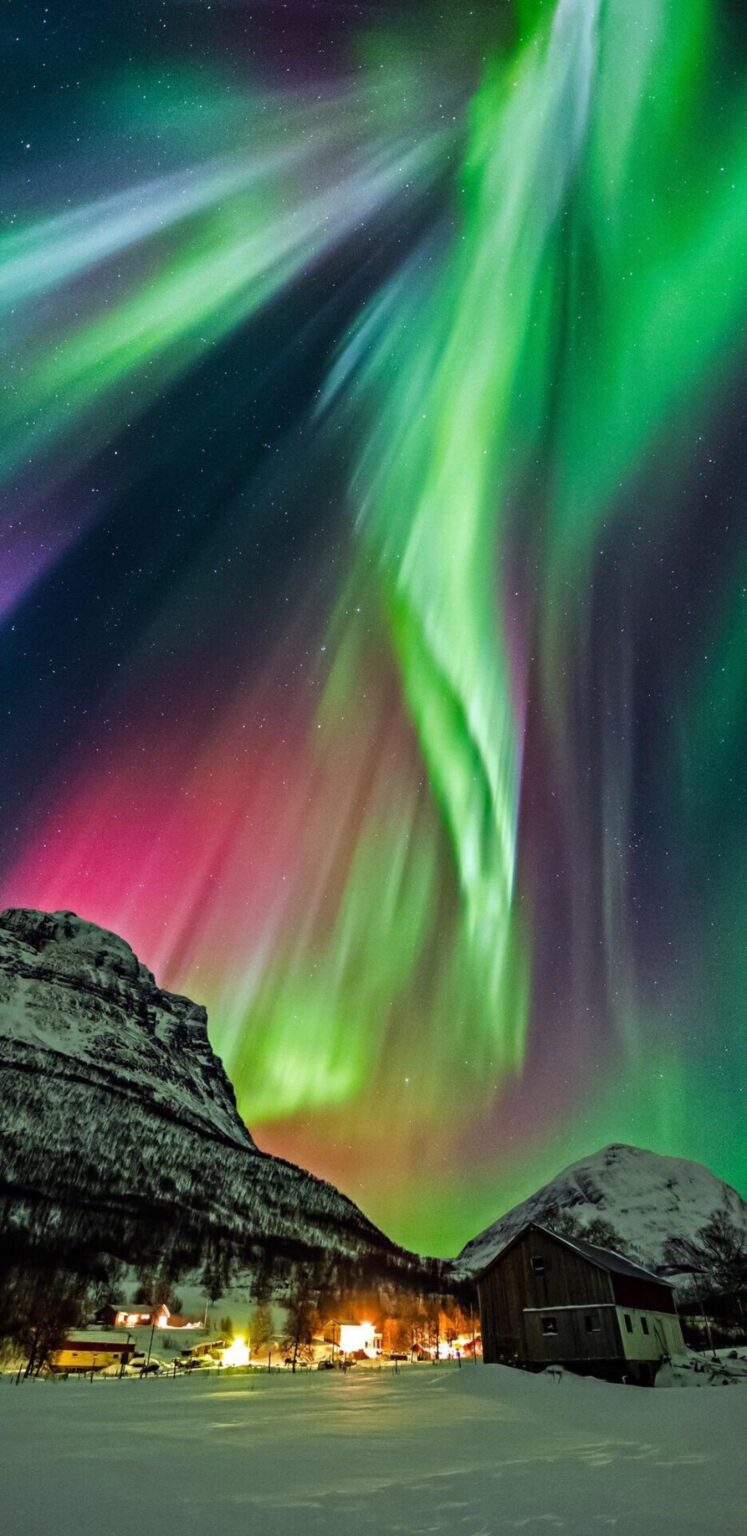

Aurora borealis or avróra is the radiance of visible light in the upper atmosphere, visible at night. This wonderful natural phenomenon was probably named aurora borealis or northern lights by the French astronom Pirre Kasenti in 1621 after the Roman goddess of the morning dawn Aurora. It was described long before him by Aristotle and Pliny . The aurora borealis is described in various myths of Scandinavian nations and Eskimos, where it has a supernatural meaning. In the southern hemisphere, the same phenomenon is observed, British explorer James Chooche observed it in the southern Indian ocean and in 1773 named it aurora australis.
The aurora borealis is most commonly seen in two oval bands around the earth’s magnetic poles, at an approximate “magnetic latitude” of 70 degrees. It occurs at an latitude of about 100 km (thermosphere ). In areas below the oval band, aurora borealis can be seen almost every clear night. At mid-latitudes, aurora borealis is very rarely seen, most often as a faint glow on the horizon toward the pole. On rare occasions, after very strong eruptions in the Sun, an oval of aurora borealis descends to the south (or north in the southern hemisphere) and is then seen higher in the sky even at mid-latitudes . Best seen in autumn as well as in spring.