
Danish is a language that belongs to the Germanic group of languages and is spoken by about six million people, mainly in Denmark, as well as in Greenland and the Faroe Islands, alongside the use of local languages and dialects.
During the period from 200 to 800 AD, the Vikings – and therefore Denmark – had a significant influence on northern Europe. At that time, the Old Norse language was used. The three Scandinavian countries today; Denmark, Sweden, and Norway, spoke the same language then.
Danish began to change more significantly during the Middle Ages, when Christianity replaced the old Norse religion. During this time, many German and Latin words were adopted, which had a strong influence on the development of the language.
The standardization of the language began more than 400 years ago, in the 16th century, while spelling reforms, that is, reforms of literary Danish, were carried out during the 19th and 20th centuries.
One of the things that particularly interested me when we arrived in Denmark was how similar the Scandinavian languages actually are. We learned that Danish and Norwegian are very similar, at least in written form. As an example, we were told that a message a Norwegian sends to a Dane in Norwegian would look almost the same as if it were written in Danish.
When it comes to spoken language, the situation is similar, but understanding depends on which part of Norway a person comes from because – just like in Slovenia – there are many different dialects. Some are easier and some more difficult to understand.
As for the Swedish language, we were told that with additional context it is possible to understand what is being said, but only at a basic level, and comprehension is not as easy as between Danish and Norwegian.
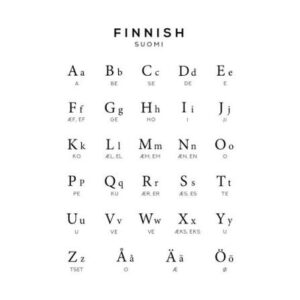
Unlike the standard alphabet, the Danish alphabet consists of 29 letters, of which 26 are standard Latin letters, with three additional ones: æ, ø, and å.
One interesting fact is that the longest Danish word can have more than 50 letters.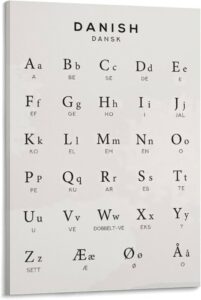
Unlike the German language, Danish uses only two grammatical genders – common and neuter. Verbs do not change according to person, and similarly to the language spoken in North Macedonia, Danish does not have grammatical cases.
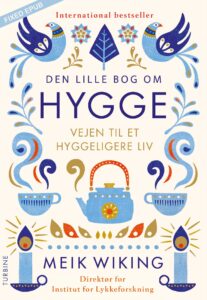 In the Danish language, one particularly interesting concept is the word “hygge.”
Hygge is a word that describes a concept of comfort, togetherness, and enjoyment in the small things in life. It is often associated with Danes, who even have the Happiness Research Institute. It is pronounced somewhat unusually (hue-guh or hoo-gah) and is difficult to translate precisely, but it is used in a similar way all around the world.
Examples of hygge moments include drinking coffee and watching a series while it is raining outside, spending a quiet evening with family, or simply finding joy in everyday moments. Anything that brings a feeling of happiness, safety, and inner well-being can be described as hygge.