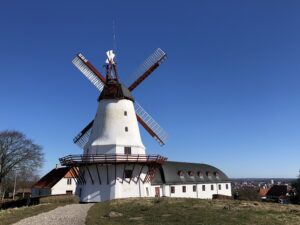

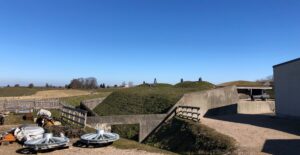
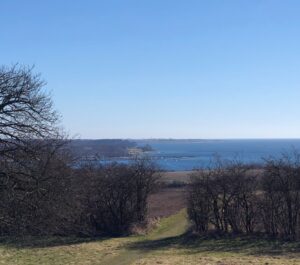
In the late morning I went on a little trip with our two teachers. We went to have look of the once battlefields, on the edge of Sønderborg. The walk took us about 30 minutes, trough the city, then a little up hill to the windmill/ museum.
The use of water- and wind power is the oldest energy producing source in the world.
The first mills were operated by means of hydropower.
Unfortunately, falling water levels in streams and little rivers meant that small mills were unable to use.
Small windmills were often built next to the large water mills in order to supplement them when there was not enough water.
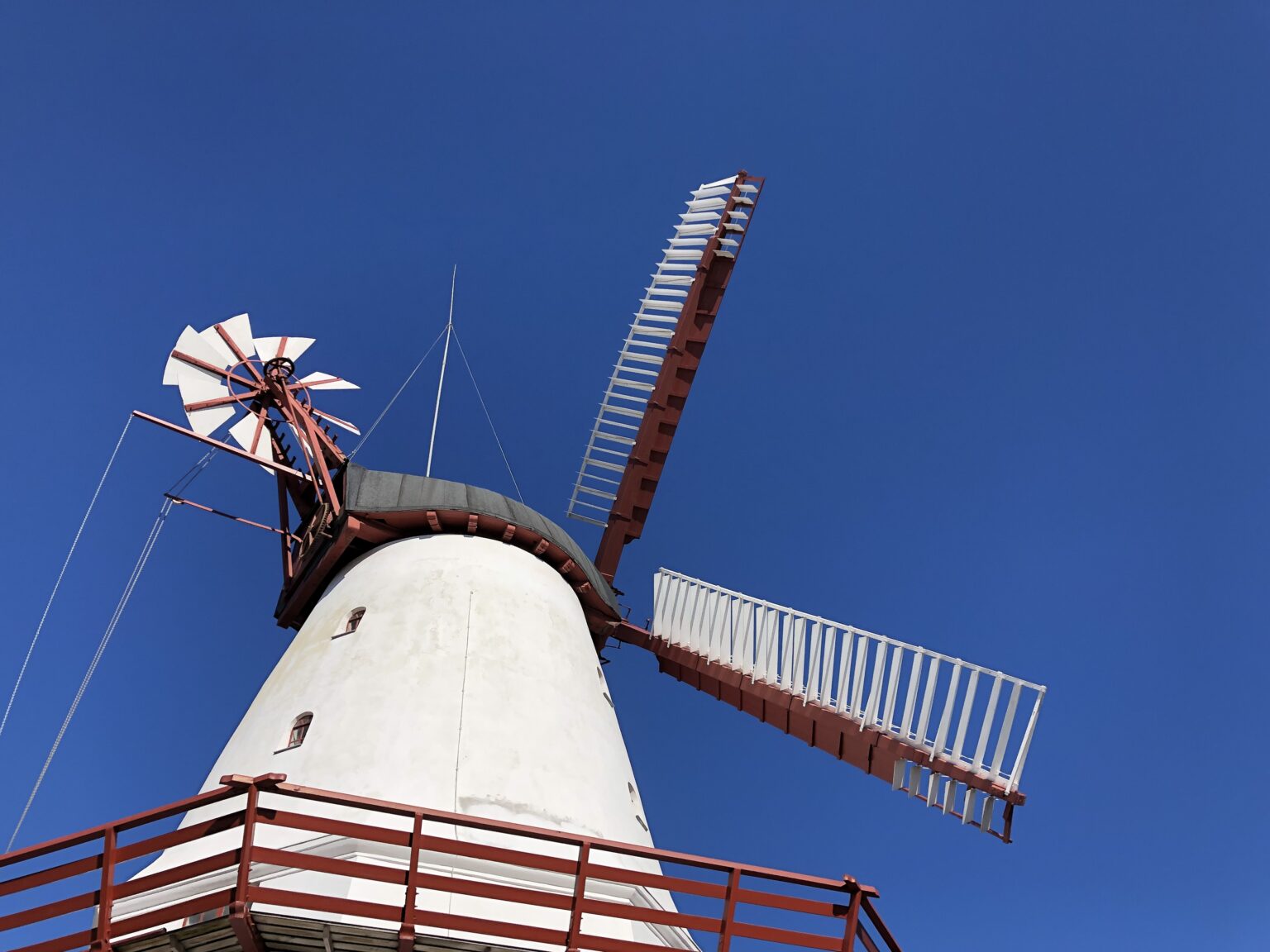
The mills were usually built of wood, which is why fires posed a threat to them. Whenever a storm was approaching, the miller had to make sure that the wings were secured so the mill wouldn’t get out of control.
Building a mill was expensive so it was often the king or a duke who paid for the construction.
Thunderstorms and wars influenced the lifetime of the mill. So the mill standing on Dybbøl Banke today is actually the fifth mill on this site.
1744 – 1800
The first mill stood here for 56 years before it was struck by lightning during a thunderstorm and burnt down.
1800 – 1849
The next mill was burned down after being hit under bombardments during the First Schleswig War (1848-50) also known as the Three Year´s War.
1853 – 1864
Due to the war, the rebuilt of the third mill was postponed. The Second Schleswig War or the War in 1864 transformed Dybbøl Banke into a battlefield; the mill was bombarded again and burned down.
1864 – 1935
Denmark lost the war in 1864 and Southern Jutland and the Sønderborg-area was occupied by the Prussians and the next mill was built under the German rule. During the time of the industrial revolution electricity was introduced and unfortunately a short-circuit lead to a fire, burning the mill down to the ground.
1935 –
The mill you see today is almost a spitting image copy of the one built in 1864. The current mill was in operation until 1990, after which it was converted into a museum.